
(This post is companion to a YouTube video posted in April 2026.
Watch the video here.)
Stopping retightenings was easy once I had made up my mind. But deciding what to do next with my Sisterlocks took a little while. I knew I didn’t simply want to leave everything untouched.
I had been concerned about the thickness of some of my locs, particularly around my hairline, and I wanted to find a way of creating stronger, thicker sections without continuing to put too much tension on my scalp.
So, I started experimenting with combining.
I’ve tried three different approaches to combining my locs.
1. Combining the hairline
I have naturally thin edges, and some of the Sisterlocks around my hairline were very thin.
As they grew longer, I became increasingly concerned about the extra weight those thin locs were carrying.
About a year ago, I experimented with combining some of them.
Where I had two very thin Sisterlocks next to each other. I snipped one of them near the root, leaving part of the original Sisterlock intact, then undid the loc by gently unravelling the interlocked sections until the hair was loose. I then incorporated the loose hair into the neighbouring lock.
Over time, the new growth was incorporated fully into the thicker lock.
The result is interesting because you can still see the original, thinner section further down the loc, but the root has ‘grown out’ much thicker.
I’ve done this with a few of the locs around my hairline.
Have already combined some of the hairline locs in the past, I used that knowledge to try a couple of different combining approaches on the rest of my hair.
2. Plaiting the whole Sisterlock
The second method I’ve tried is simply plaiting Sisterlocks together.
I experimented with three individual Sisterlocks, plaiting them together from the root all the way down to the end.
One of the locs was longer than the other two, but after several washes they seemed to have begun to marry together.
It’s a surprisingly simple approach.
I’ve only done this with one section, though, and ultimately decided that it wasn’t the method I wanted to use throughout my hair.
The plaiting method was interesting, but not quite right for me. But it helped lead me to the method I have settled on.
The third method involves combining.
But instead of combining the existing locs themselves, I combine the regrowth only.
3. Combining the regrowth
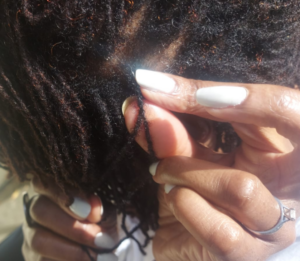
I take two or three neighbouring Sisterlocks and lightly plait the new growth together at the root.
The locs themselves remain separate further down, but the roots, now joined, will continue growing together as one unit.
Sometimes there is a little extra loose hair left over from the plaiting, which I incorporate by wrapping around the base of the newly-joined locs.
This approach makes the most sense for what I’m trying to achieve.
I’m not trying to recreate the tension of a retightening. I’m trying to allow the hair to grow together into a thicker, stronger root.
And I don’t need to do it all at once.
It isn’t a perfectly planned process
There are still some individual Sisterlocks scattered among the combined ones.
That’s partly because I didn’t approach this with a diagram or a master plan.
I would often sit watching television and feel the locs with my hands, deciding which ones seemed as though they would benefit from being brought together with other locs.
If one loc was left on its own, I’d simply leave it like that for the time being.
When there is enough regrowth, I can combine it with a neighbouring loc, without adding unnecessary tension to the root.
So this is very much a process rather than a finished result.
Keeping the hair soft
One thing that helps is a simple aloe vera spray.
I make mine with 50% aloe vera juice and 50% purified water and keep it in the fridge.
I find that it gives the hair a little softness and makes it easier to work with when I’m combining the regrowth. I don’t want the hair soaking wet, but I also don’t particularly want to manipulate it when it is very dry.
I’m still experimenting…
This whole journey is an experiment for me.
I stopped retightening because I wanted to reduce tension and pay more attention to what was happening with my hair.
Combining is part of that experiment.
I’m interested in seeing what happens when I have fewer, thicker units rather than a large number of very small ones.
I’m also interested in what happens to my scalp and my hair over time when I stop trying to maintain the original structure so rigidly.
For now, I’m taking it slowly.
There are no rules.
I’m simply finding out what works for mine.
And I’m very curious to see where it takes me.
💜
I’ve been documenting this journey on my YouTube channel.
Come and follow along over there: Love Those Locs on YouTube